
Conscience does make cowards of us all
Understanding Hamlet and Lear with help from Kierkegaard

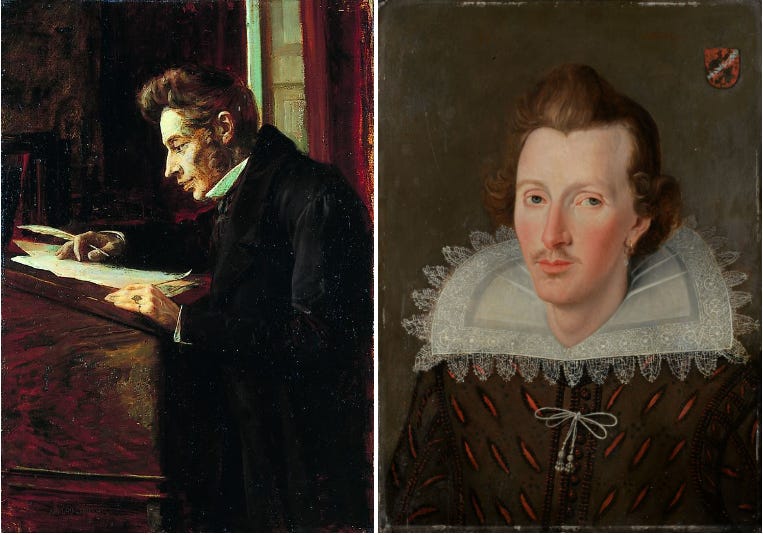
Poetry can be difficult to comprehend fully, both because of elevated — and often archaic — language, but also because good poetry is often layered with meaning, some of which can be difficult to be teased out, or even to be aware of. This is why good teachers and guides can be so helpful, by taking us not only through, but underneath the topmost layers of meaning. Shakespeare’s language is not especially difficult, but his layered meanings, often built upon ironies that, as G.K Chesterton remarked of Chaucer’s, are sometimes too large to see. In part, I hope that my essays serve as helpful guides, and if they do, it’s only because others have guided me. In this essay, I’d like to show how the Danish philosopher Soren Kierkegaard’s work on human psychology can help us to extract greater meaning from Shakespeare, and, I’m sure, from other great poetry. Here, I will focus on King Lear and Hamlet.
Kierkegaard is today thought of principally as a theological philosopher, but along the way, he also developed a theory of personality that is very close to how modern psychologists understand the subject. In fact, I hope that one outcome of this essay will be that you will see him as I do as one of the foremost psychologists ever, along, in my view, with Buddha and Shakespeare. None of them approached psychology in a scientific sense, as was Freud’s great mission, a fact that perhaps aided, rather than hindered their observations.
Two subjects I have written about recently are very dear to me: The true meaning of the parts of the Hebrew bible written by the so-called Yahwist writer, and what Shakespeare was really saying with Hamlet. I will try to show that Kierkegaard brings these together in a certain sense, though that was not his aim. Obversely, Shakespeare, as so often, seems to have anticipated psychological discoveries several centuries in advance, and for all we know, there may be plenty of aspects of human psychology that modern understanding and methods have not yet grappled with successfully, which will reverberate within Shakespeare’s work once they have been.
I only discovered after my essay on the Fall of Man story in Genesis that Kierkegaard had been the first (as far as I know) to understand it as an allegory about humans gaining awareness of our mortality. The Yahwist writer did not explore the psychological consequences of this earth-shattering awareness (other than in a rudimentary way in the Cain and Abel story), but Kierkegaard did so enthusiastically. So did, I think, Shakespeare, particularly in Hamlet and King Lear. Before discussing those plays, I’ll need to provide a very brief overview of what Kierkegaard discovered.
He understood that among all the animals, humans uniquely have consciousness of their mortality, and that enormous psychological and social consequences flow from that fact. Other animals, living in blissful ignorance of their eventual demise, live purely or almost entirely in the moment, and while they suffer stress in moments of direct danger (such as being chased by a predator), they do not suffer pervasive anxiety as we understand it (what Kierkegaard called dread). That’s because they do not possess the machinery of imagination that we do, to look backward and forward (Hamlet’s phrase) and to consider counterfactual possibilities. In fact, possibility is just the word Kierkegaard uses to describe the space and exercise of human imagination; it contains all art, all thoughts and ideas of what humans and the world might be, all the infinite space that the human mind can possibly project into.
But humans, he understood, are still animals; we have a body that consumes and excretes, that reproduces, and most to the point, that dies, and that is always in some danger of. These bodily aspects of our nature, Kierkegaard calls necessity, because, I imagine, these are all necessary elements of our being, unlike imagination. We are grounded in this necessity, in this reality principle; in fact, it defines our groundedness in this world as that which it’s clear we have no control over. We all will die, and no one can know when.
This division harkens to Cartesian duality, of course, though I hasten to say that as far as I know, Kierkegaard made no statement about his ideas defining a real structure as Descartes did. For the former, it is merely a convenient axis along which to consider human psychology. One could posit other models for the human psyche, but these poles provided Kierkegaard with enormous scope.
Rather than focussing on the possibility/necessity division as structural, Kierkegaard aims to discern how such a tool illuminates our understanding of human psyche and personality:
Man’s anxiety is a function of his sheer ambiguity and of his complete powerlessness to overcome that ambiguity, to be straightforwardly an animal or an angel [self-aware being]. He cannot live heedless of his fate, nor can he take sure control over that fate and triumph over it by being outside the human condition: The spirit [self-consciousness] cannot do away with itself… Neither can man sink down into the vegetative life [i.e., be wholly an animal]… He cannot flee from dread [anxiety].
The ambiguity referred to here is that between possibility and necessity, between the “angel” or “spirit” and the “animal.” Kierkegaard’s theory of personality (or character) is built on the premise that we build our personality to avoid — at almost all costs — being reminded of the “terror, perdition, [and] annihilation [that] dwell next door to every man.” With exceptions at the extremes of this axis, where psychoses lay, we all fashion our character after ostriches, hiding our heads in the sand from the terror of death. Most people live in greater or lesser degrees with both possibility and necessity, and the particular balance each person strikes and the ways they manage that balance is determinative of personality. These “ways of managing” the balance are what psychologists call neuroses — our repressions, defenses, rationalizations, etc. — and in Kierkegaard’s view we are therefore all neurotic to some degree.
Kierkegaard’s analysis of people along the necessity/possibility spectrum is very detailed, and maps remarkably well onto modern post-Freudian psychology. To see more about this, I commend Ernest Becker’s seminal book, The Denial of Death (The Free Press, 1973). There, he describes in detail the psychotic illnesses that result from too much of one end of the spectrum or the other (too much possibility untethered to necessity leads to what we now call psychotic schizophrenia, the inability to shut out terror, while being mired in our bodily fate with too little independence of imaginative thought leads to psychotic depression). Becker summarizes concisely the Kierkegaardian view:
The irony of man’s condition is that the deepest need is to be free of the anxiety of death and annihilation; but it is life itself which awakens it, and so we must shrink from being fully alive.
We shrink from life by assembling our protective armor with the building blocks of neuroses. One sees here the existential dilemma each of us is born into and the consequent struggle to avoid the agony of living at or near the polar extremes. We can also see that a great poet like Shakespeare would take up such a subject.
Kierkegaard describes how the vast majority of us negotiate this struggle by developing our personalities to tell ourselves lies about reality, and throughout adulthood adhering to social norms to avoid detachment from necessity. Again, Becker:
[Kierkegaard] is intent on describing what we today call “inauthentic” men, men who avoid developing their own uniqueness; they follow out the styles of automatic and uncritical living in which they were conditioned as children. They are “inauthentic” in that they do not belong to themselves, are not “their own” person, do not act from their own center, do not see reality on its terms; they are the one-dimensional men totally immersed in the fictional games being played in their society, unable to transcend their social conditioning: the corporation men in the West, the bureaucrats in the East, the tribal men locked up in tradition — man everywhere who doesn’t understand what it means to think for himself and who, if he did, would shrink back at the idea of such audacity and exposure.
Kierkegaard applied the term “Philistine” to a certain flavor of the “inauthentic man:”
Devoid of imagination, as the Philistine always is, he lives in a certain trivial province of experience as to how things go, what is possible, what usually occurs… Philistinism tranquilizes itself in the trivial.
And once again, Becker:
Why does man accept to live a trivial life? Because of the danger of a full horizon of experience, of course. This is the deeper motivation of philistinism, that it celebrates the triumph over possibility, over freedom. Philistinism knows its real enemy: freedom is dangerous. If you follow it too willingly it threatens to pull you into the air; if you give it up too wholly, you become a prisoner of necessity. The safest thing is to toe the mark of what is socially possible [i.e., permissable].
How, then, is one to be healthy, and even more, self-realized in some sense, in such a world of inherent dilemma, bearing in mind that it is death-awareness that creates this dilemma? How does one transcend the repressions and other devices developed in childhood and rutted in adulthood? Kierkegaard thought about that, too, described here by Becker:
In order to transcend himself he must break down that which he needs in order to live. Like Lear he must throw off all his “cultural lendings” and stand naked in the storm of life. Kierkegaard had no illusions about man’s urge to freedom. He knew how comfortable people were inside the prison of their character defenses. Like many prisoners they are comfortable in their limited and protected routines, and the idea of a parole into the wide world of chance, accident, and choice terrifies them…
Anxiety is the result of the perception of the truth of one’s condition. What does it mean to be a self-conscious animal? The idea is ludicrous, if it is not monstrous. It means to know that one is food for worms. This is the terror: to have emerged from nothing, to have a name, consciousness of self, deep inner feelings, an excruciating inner yearning for life and self-expression — and with all this yet to die.
Kierkegaard provides a solution to the dilemma, which in a word is faith. Although he was a Christian, Kierkegaard means something much more general and cosmic than any specific religious faith: Becker explains that he is talking about
the mystery of the private, invisible, inner self which yearn[s] for ultimate significance, for cosmic heroism. This invisible mystery at the heart of every creature now attains cosmic significance by affirming its connection with the invisible mystery at the heart of creation. This is [Kierkegaard’s] meaning of faith.
Now, with this brief outline of Kierkegaard’s framework of personality, let’s have a look at how these ideas might map onto Hamlet and Lear. We’ll begin with Lear, as his is the simpler case.
The quotation of Becker above speaks directly of Lear: “... he must throw off all his ‘cultural lendings’ and stand naked in the storm of life.” King Lear begins with an old king who deluded himself in all sorts of ways, none with more consequence than what love was. Through the course of the first four acts, he is forced, in scene after scene, to confront reality to the point where he can no longer deny it. In Kierkegaard’s prescription for transcendence that includes faith, what is required is learning in the “school of anxiety,” that is, to strip oneself of one’s neurotic “lendings,” i.e., to dismantle personality. That is both literally and metaphorically what Lear does, stripping off his clothes — and with them, all his defenses — in the storm scene. What a superbly theatrical and poetic metaphor!
Lear thus arrives at a place of equanimity, where he can recognize himself as the cause of Cordelia’s pain without a word from her about it (in the end, something does come from nothing!). He also recognizes the foolishness of his narcissism, seeing now a world outside himself. But, if Lear is to be fully transcendent in Kierkegaard’s sense of becoming completely unfettered by the constraints of the human dilemma, he needs to have faith. In what? Perhaps it’s expressed in the extraordinarily moving passage below, where he is consoling Cordelia about their impending imprisonment:
Come, let’s away to prison.
We two alone will sing like birds i’ th’ cage.
When thou dost ask me blessing, I’ll kneel down
And ask of thee forgiveness. So we’ll live,
And pray, and sing, and tell old tales, and laugh
At gilded butterflies, and hear poor rogues
Talk of court news, and we’ll talk with them too —
Who loses and who wins; who’s in, who’s out —
And take upon ’s the mystery of things,
As if we were God’s spies. And we’ll wear out,
In a walled prison, packs and sects of great ones
That ebb and flow by th’ moon.
They’ll sing like caged birds! Lear now understands that he is in a cage, with his animalistic necessity (particularly death; recall that Lear is over eighty), but he is now free enough to sing, even while caged. More than sing, they’ll pray, tell stories, laugh and enjoy beauty — they’ll do all the living things. Even more, they’ll study the mystery of things — note that it’s not mysteries; he’s talking about The mystery, whose secret perhaps even God doesn’t know, and who needs to send out spies to learn. Imagine! to be human and yet on the same level as God. This is the essence of Kierkegaardian transcendence, on a cosmic scale. Perhaps, then, the face of Lear’s faith is having the freedom to do these things — to live.
Having written about the centrality of blessing in the Hebrew bible, I am urged to mention the beautiful reference in these lines to Psalm 32:1, which states, "Blessed is the one whose transgressions are forgiven, whose sins are covered." Lear, then, is not merely showing a new-found humility in saying that Cordelia’s request for his blessing will be responded to by his requesting forgiveness, but he’s inverting the situation, showing that he’s ready to receive her blessing. With this insertion, I think Shakespeare sets up a tone for Lear’s imagined future together as one of the most loving platonic intimacy. It’s lovely.
The situation for Hamlet is quite a bit more complex, though I’ll begin by noting that from a Kierkegaardian perspective, Hamlet is quite the opposite of Lear: I will argue below that whereas Lear’s trajectory was a straight line from being deeply embedded in necessity to reaching escape velocity toward transcendence, Hamlet’s trajectory is in the opposite direction, and that is his tragedy. In his intellectual capacity, and especially in imaginative power, he is unsurpassed in literature. And then the balloon that carries him to such lofty heights bursts. Let’s see why.
Hamlet has none of Kierkegaard’s “inauthentic man” in him, but he is surrounded by them, much to his irritation. In fact, as I have written about, Hamlet’s tragedy is in large measure due to his nearly absolute intolerance of inauthenticity in others. Polonius and Osric are the epitome of inauthenticity (note the differences in how Hamlet treats each of them: He is scornful, mocking, and sarcastic toward Polonius, but has rather gentler fun with Osric, the second coming after Hamlet’s descent into fatalism), but nearly everyone in the play is corrupted in some way. Hamlet is very much his own man, with a freedom and power of mind that has been the envy of the world for over four centuries.
I am not arguing that Hamlet is free in the Kierkegaardian sense; he most emphatically is not. But he soars very high into possibility. What fetters his transcendence into freedom? At least two different things I can think of. The first — a reminder of the most important component of Kierkegaardian necessity — is the constant weight of death on Hamlet throughout the play. The Ghost of his father is present in every scene, whether he’s actually in it or not. Death is with Hamlet from the moment he first sees the ghost until he dies. Transcendence into freedom is difficult if you’re mired in and constantly confronted with death.
The other hindrance to Hamlet’s transcendence relates to a lack of grounding. Hamlet has loads of possibility - perhaps more than any personality ever devised. He is also solidly grounded in necessity — the reality principle. That’s why he is so good at sussing people out. But he has a singular destabilizing deficit here. He cannot accept the reality that no one else at Elsinore is anywhere near as full of possibility as him. Hamlet is separate and alone due to his imaginative and mental powers (which I argued in my previous essay is the true source of his melancholy). Much of his railing and sarcasm are responses to the anxiety he feels about his separation from everyone else. This is a more serious deficit than may first appear, as it denies an essential aspect of reality. As we’ll see in a moment with Ophelia, destabilizing attachment to necessity can have disastrous consequences.
Toward the end of the “To be or not to be” soliloquy, Hamlet says, “Thus conscience does make cowards of us all” (recognizing that Elizabethans understood the word “conscience” as we understand “consciousness”). As so often, Shakespeare is working on several levels of meaning at once. On the surface level (what a surface!), Hamlet means that consciousness of death — here we are again at what Kierkegaard first recognized as the true meaning of the Fall of Man story! — is what makes us shrink from suicide in spite of our suffering. But it also is the statement that we fear to fly too high because without being properly grounded, madness that way lies, as discussed above. Shakespeare, speaking through Hamlet, intuits this 250 years before Kierkegaard. And how delicious is it that Hamlet feigns madness throughout the play? Another testament to Shakespeare’s artistry.
I pause here to note the proximity of the one actual case of madness in Hamlet: Ophelia’s. She appears to have had a schizophrenic psychotic break shortly before her suicide (compare, too, Hamlet’s mere contemplation of “self-slaughter” with her actual achievement). Why did she become so completely untethered? How did she leave her necessity behind? Our groundedness is in recognizing necessity, what is real, which places crucial limits on the expansive quality of possibility. In the nunnery scene, which comes directly after Hamlet has declared that “conscience does make cowards of us all,” he destroys Ophelia’s hold on reality when he tells her that he doesn’t love her (whatever his motivation, which I discuss here). Her brother is gone, and her father is abusing her in his schemes. All she had left to count on was Hamlet’s love, and he smashes that to smithereens, (with the irony that he believes he’s doing this for her sake). The ground of her reality has been swept away, and off she goes, floating wherever her mind takes her until she is discovered drowned in the brook.
I argued in a previous essay about Hamlet that he loses the core of himself, thus bringing about his tragic ending. This begins as soon as the scene where he observes Claudius praying. The balloon keeping Hamlet aloft has begun to leak. Let’s look at the point when it burst, precipitating Hamlet’s careening to the ground from so high an altitude, where he crashed and died.
Act IV, scene iv is often omitted in productions to save time. That’s an enormous mistake, because it not only omits one of the great soliloquies, but it ignores meaning central to the play. This is where Hamlet, sent off to England to be killed by Claudius, encounters some Norwegian soldiers crossing Denmark to take a worthless plot of land in Poland, which spurs Hamlet’s mediation on action. In what really should be considered the start of that soliloquy, Hamlet first remarks
Two thousand souls and twenty thousand ducats
Will not debate the question of this straw.
This is th’ impostume of much wealth and peace,
That inward breaks and shows no cause without
Why the man dies.
“Impostume” is an archaic word meaning “abscess.” On the surface, he’s talking about the corruption of a state (Norway) that sacrifices two thousand lives and much fortune for a worthless piece of land, and that this corruption, like an abscess, will break open — inwardly — release its poison, and kill the host, leaving no trace of the cause of death. On a deeper level, though — always look for more levels in Shakespeare! — it can be read with the individual as the subject (Shakespeare often compared the nature of the state with that of the individual). In a person’s mind, an infection might take hold and grow an abscess to the breaking point when it contaminates the mind with its poison. Hamlet is foretelling his own death!
And if the artful beauty of this metaphor were not enough, our poet heaps on top of it, through the use of this unusual word impostume, a callback to the main theme of the play: Identity. Recall that the very first words of the play are “Who’s there?” What unfolds in the first four acts is Hamlet — playing at acting more than acting out the ghosts orders — searching for who he is. In his playacting, he is trying out various personas, acting different parts. Can it be an accident that Shakespeare uses the word “impostume,” so homophonic to “imposture” and “impostor” in this central soliloquy? Such wordplay is precisely in the style of Shakespeare’s art. The artfullness is of such astonishing enormity that one begins to believe he must be of some alien race.
This “inward break” will be Hamlet’s undoing, and we don’t have to wait long for it. In the soliloquy immediately following (“How all occasions do inform against me”), Hamlet works himself up into a lather, berating himself for not acting out his revenge yet. Before we get to his frothing, though, let’s examine the first half, where he makes several remarkable observations.
How all occasions do inform against me
And spur my dull revenge. What is a man
If his chief good and market of his time
Be but to sleep and feed? A beast, no more.
Sure He that made us with such large discourse,
Looking before and after, gave us not
That capability and godlike reason
To fust in us unused. Now whether it be
Bestial oblivion or some craven scruple
Of thinking too precisely on th’ event
(A thought which, quartered, hath but one part wisdom
And ever three parts coward), I do not know
Why yet I live to say “This thing’s to do,”
Sith I have cause, and will, and strength, and means
To do ’t.
These are some of Shakespeare’s most existential lines, up there with “Tomorrow, and tomorrow, and tomorrow,” and are perhaps the ones most directly connecting with Kierkegaard. He states clearly that there must be more to man than the same bodily existence shared with “beasts.” Of course, Hamlet would say this — more than any other character (except perhaps Falstaff), Hamlet understands that life is about possibility. He makes this clear in the third sentence, describing our “godlike reason.” All very well. Then he says that he doesn’t know which, but the only explanations for his delay are either over-thinking or under-thinking, the latter captured by the phrase “bestial oblivion.” Both are, I think, red-herrings by and for himself, but either will do to rationalize his movement to action, which he proceeds to pump himself up about. In the rest of the soliloquy he is merely working himself to a frenzy, but the work is already done: He has his “reason” to act. (To be precise, he's given himself two mutually exclusive reasons, without deciding which one is correct; surely that's a sign that neither is.)
Not incidentally, Hamlet had just recently deluded himself in just the same way, so it should be no surprise that does so again here. Hamlet’s rationalization for not killing Claudius when he finds him at prayer is that the latter would then ascend to heaven, which Hamlet cannot abide. He’d rather wait and send him to hell, he says. But, as Harold Goddard notes,
In his heart, Hamlet does not believe in blood revenge in any circumstances… Who at one time or another has not assigned a worldly motive to a noble impulse? Then why not, in an extreme case, an infernal motive to a celestial impulse? The celestial impulse here is to save, hence, the expressed will to damn. Hamlet has a conscious belief that he ought to kill the King. He has an unconscious conviction that he ought not to. To hold the latter powerful conviction under the threshold, consciousness must invent a correspondingly powerful pretext for suppressing it. And that is exactly what Hamlet’s consciousness does here and why we all feel that what he says is totally out of character. A man’s consciousness is the merest surface of his self.
I suggest that the twin red-herrings offered by Hamlet to himself that spur him to action are exactly the same sort of self-delusion as Goddard describes having held him back from killing Claudius in the prayer scene. I have emphasized before that if we’re not careful, we can miss Shakespeare’s irony, and with it, essential meaning. These rationalizations don’t look like red-herrings until you get underneath them to see them for what they are.
The rest of the speech is merely his lathering himself up, ending with the pledge, “from this time forth / My thoughts be bloody or be nothing worth!” But the turning point between the rationalization and the pep-talk is his exclamation that “examples gross as Earth exhort me,” after which he proceeds with his sarcastic, belittling examples why he has every reason to act on the ghost’s command. I may be making too much of it, but my experience is to keep an ear out for such grandiose phrases as “gross as Earth;” they’re often a marker of something important in Shakespeare. I think the grandiosity itself is the point here. Just as a sports coach will exaggerate in exhorting his players to give their all or more aptly, for a lieutenant to spur on his troops, Hamlet makes the issue as large as the Earth. He must do this to overcome his reason and values — his true self — which would exhort him not to go ahead with revenge. He must also overcome the insufficiency of the twin red-herrings he's deluding himself with.
And so he lands on his bloody thoughts and is doomed. The impostume has broken inwardly, the balloon has burst, and Hamlet’s descent and destruction are inevitable.
Kierkegaard’s analysis of personality is only a lens through which to understand Lear and Hamlet (and, I’m sure, many other fictional — and non-fictional — characters). But I think it’s one that helps us to capture important meaning that might not be so evident without it. Lear’s transcendence and Hamlet’s fall are among the most poignant and dramatic portrayals in literature. These are reasons enough why their stories have captivated us for more than 400 years. But Kierkegaard points to another one: They offer us insight that lies at the very heart of human nature. We can thank both Shakespeare and Kierkegaard for these revelations.